
System Topology Explanation
Our HSP-A40 Type 2 AC SPD series is compatible with TN‑S, TN-C-S and TT systems. IT systems require specially evaluated SPD solutions. TN-C system is shown in the wiring diagram for reference only. It is generally not used for new building power installations nowadays, mostly only seen in older legacy installations.
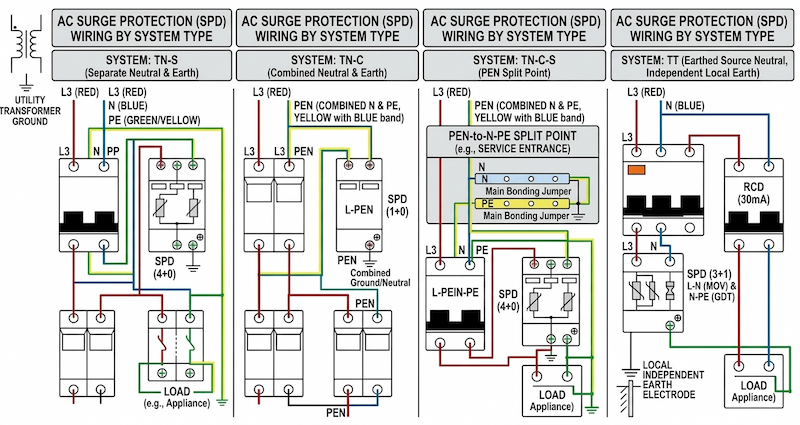
(Note: For TT systems, the grid neutral is earthed at the transformer, while equipment uses independent local earth electrodes.)
1. TN-S System (Three-Phase Five-Wire)
Characteristics: 3P+N+PE. Neutral and PE split after transformer earthing point.
Advantages: Stable earthing; no neutral drift shock risk.
Installation: Parallel phase-to-PE & inter-phase wiring.
Application: Hospitals, data centres, precision workshops.
2. TN-C-S System (PEN Combined Earthing)
Characteristics: Shared PEN upstream; N and PE separate after the split point.
Advantages: Lower wiring cost, combines TN-C & TN-S benefits.
Installation: Parallel phase wiring; split PEN at building incoming cabinet.
Application: Factories & buildings with partial power safety upgrades.
3. TT System (Independent Local Earthing)
Characteristics: Grid neutral earthed separately; equipment has independent local earth.
Advantages: Prevents fault potential transfer to equipment enclosures.
Installation: Phase & neutral connect to grid; dedicated separate earth for equipment.
Application: Rural / outdoor supplies with no public shared PE line.
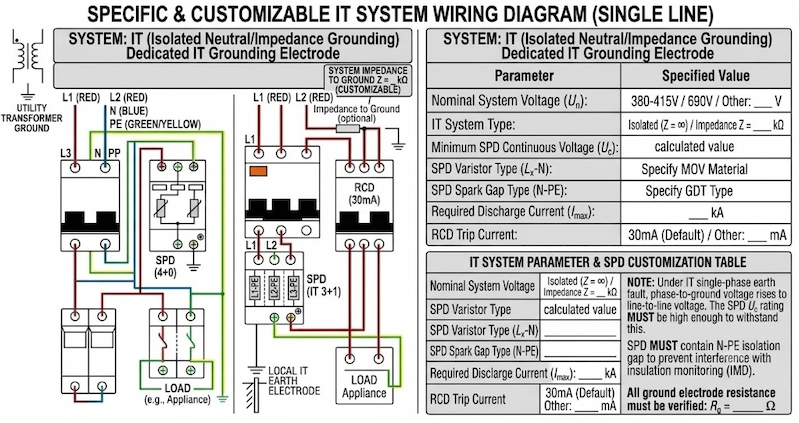
4. IT System (Isolated Neutral)
Characteristics: Source neutral ungrounded or high-impedance earthed.
Advantages: Continues running; single earth fault will not cut power.
Installation: Fit IMD insulation monitor between phase and earth.
Application: Hospital ORs, mines, chemical plants (zero-interruption critical loads).